Research
Completed and ongoing projects in Michael Purugganan’s lab at NYU, where I am a PhD student:
Dispersal of rice to Taiwan and Island Southeast Asia
The Austronesian expansion represents one of the largest pre-historic migrations we know of, and is believed to have spread out from Taiwan to Island Southeast Asia, Polynesia, Melanesia, and all the way to Madagascar over a period spanning more than three millennia starting between 3,500 and 5,000 years ago. This led to the spread of Austronesian languages, cultural practices, and a common set of domesticated crops and animals including bananas, taro, and pigs.
The movement of Oryza sativa (Asian rice) into much of island Southeast Asia has also been linked to the Austronesian expansion, but whether rice agriculture in island Southeast Asia arrived from Taiwan remains unresolved. Collaborating with a team of population geneticists, archaeologists, and anthropologists, I reconstructed the routes of dispersal of O. sativa ssp. japonica rice to Taiwan and the northern Philippines using whole-genome resequencing of indigenous rice landraces coupled with archaeological and paleoclimate data. Our results indicate that traditional landraces grown in island Southeast Asia today likely has origins in mainland Southeast Asia, while Taiwanese indigenous landraces represent ancient hybrids between northern temperate varieties and tropical Southeast Asian varieties.
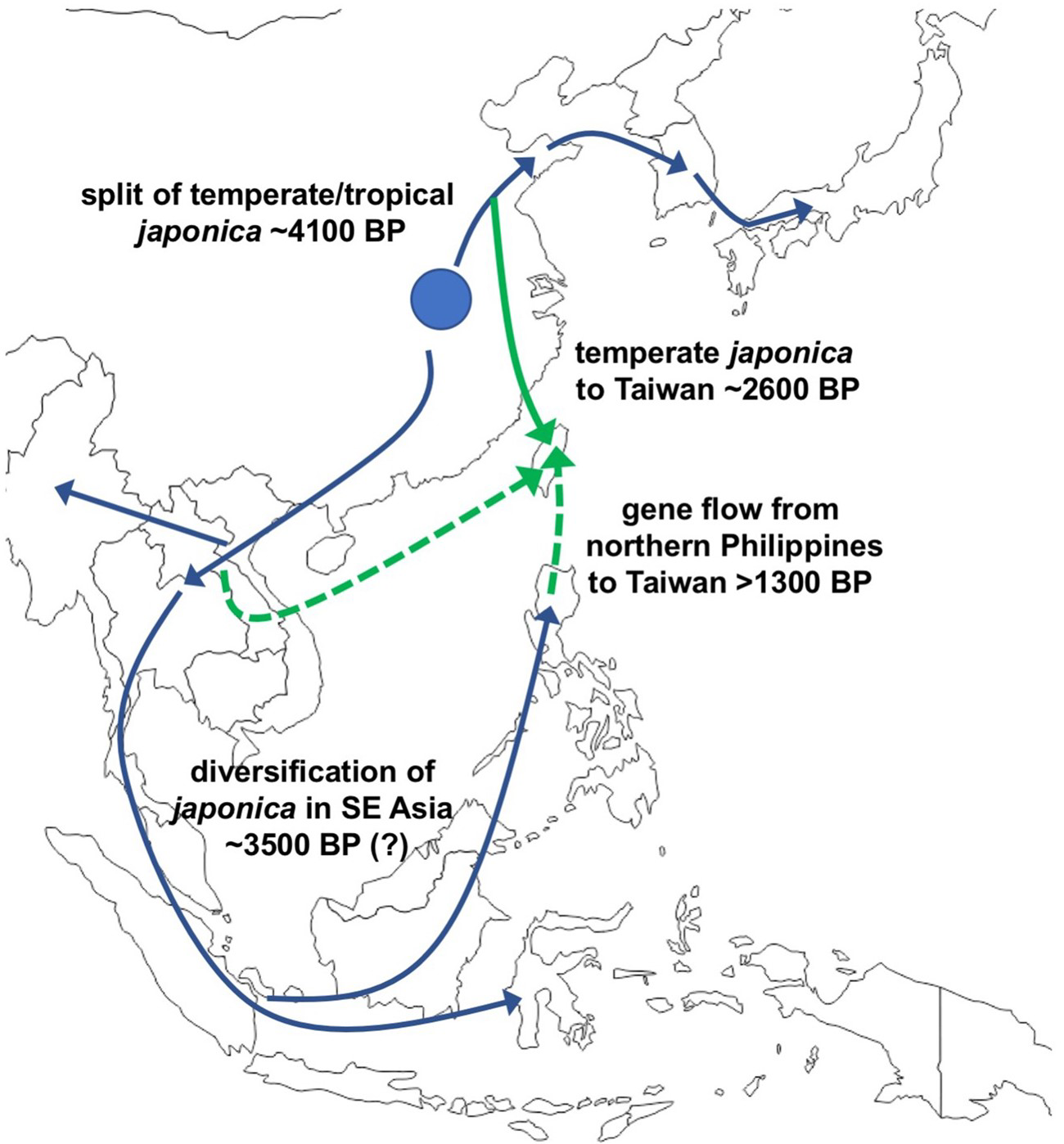
Schematic model of the movement of japonica rice into Taiwan and SE Asia
Read the paper
Behind the paper
Using herbarium genomes to reconstruct early dispersal of rice in China and neighboring regions
Using whole-genome resequencing of herbarium specimens of O. sativa collected by collaborator Rafal Gutaker (at Royal Botanical Gardens, Kew) and myself, I am investigating the post-domestication history of rice in China and mainland Southeast Asia.
Connecting the unusual site frequency spectrum of domesticated rice to its biology
This project is broadly concerned with the accurate inference of population histories in non-model species. Demographic inference refers to the inference of demographic history — including population size changes and divergence times between populations — from whole- or partial genome sequencing data from a sample of individuals. This is a powerful tool to study past and ongoing processes shaping genetic diversity in natural populations and has been widely applied in studies on recent human evolution. Most demographic inference methods employ theory and assumptions that are largely upheld for humans but frequently violated in species with different breeding systems and biology. Using mostly human-centric methods to study less understood non-model species requires further validation or adaptation of the tools to provide accurate and interpretable results. I am tackling this problem in the context of domesticated Asian rice (Oryza sativa) — specifically its non-traditional, U-shaped allele frequency spectrum and what that may imply about its biology — by making use of extensive, flexible simulations in an ABC (approximate Bayesian computation) framework and considering new ways to validate inferred population histories.
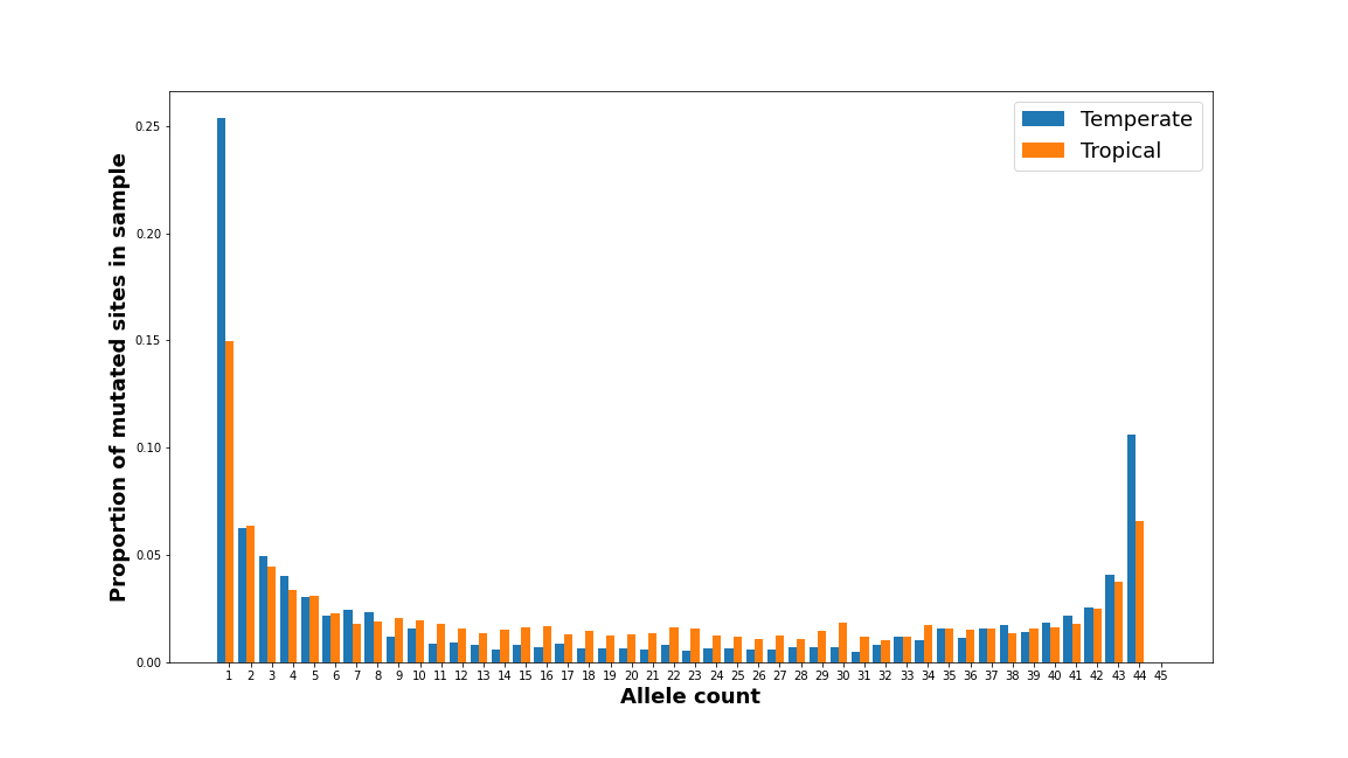
U-shaped site frequency spectra of temperate and tropical japonica rice
While I was a Research Associate at the Center for Health, Population, and Development in Independent University, Bangladesh:
The social impact of the 1947 Partition in East Pakistan (now Bangladesh)
The Partition of British India into India and Pakistan in 1947 led to massive social upheaval and violence amidst migrations of Hindus and Muslims to India and Pakistan, respectively. The traditional view of the aftermath and impact of Partition is centered on rapid and turbulent mass migrations in Punjab at the border between West Pakistan and India. At the eastern border in Bengal between East Pakistan and India, migrations followed a different pattern, taking place over a prolonged period and possibly driven by demographic forces.
I led the Bangladeshi arm of a project spearheaded by Jennifer Leaning and Shubhangi Bhadada at the Harvard Lakshmi Mittal and Family South Asia Institute, on the social impact of Partition in the region. I recruited and trained a team of undergraduates to identify and interview individuals who had migrated to East Pakistan from India in the aftermath of the 1947 Partition (or their descendants), in an effort to understand how their lives have been shaped by the migration. Based on the interviews, historical documents, and (a little) archival research, I co-wrote a chapter on the circumstances surrounding and following migration to East Pakistan after 1947. We highlight the possible roles on pre-Partition migration and kinship networks across Bengal, and new economic opportunities in East Pakistan in shaping patterns of migration to East Pakistan.